Google Docs:
My group's first version of our Two Minutes Video:
My group's final draft:
My group and I improved our video by makng our slides stay on longer so that we could reach the time needed for the video. We also added some pictures and fixed our credits at the end and included all the websites that we used. We decided to talk more about ways that people can go out and make a difference. Another thing we did is add a thought provoking question to get the audience thinking. I think that the student comments were helpful because by seeing what my peers had to say, their thoughts, and opinions, it made us realize the different ways we could improve our video.
We did not include an expert in our video simply because we weren't able to contact anyone. We found some possible experts but when we tried to call them, they didn't answer. We actually talked to someone from World Vision and they told us to call them back in the evening, which we did. However, when we called them, no one answered.
My group's greatest success was the fact that we raised a total of $150 in donations. We were at Superstore for less than an hour, and I'm very surprised that we raised so much! We even got donations from former Sargent Park Students and we met many new people. The skills that I was able to take from this project was making sure I met a due date. There was so much to do with this project in so little time. With the help of my group, we were able to have a finished product that is better than we could ever imagine.
What frustrated me in the movie making process was finding pictures, the editing, finding an expert and the fact that my group didn't always cooperate. We had to try to make sure that all our pictures were from creative commons and were related to our topic. This was difficult because there weren't that many pictures that had to do with our topic. The editing was frustrating because iMovie was sometimes difficult to work with and hard to use. My group and I got together everyday to try to find an expert but sadly, we weren't able to contact any. My group and I didn't always cooperate because we all had our own strong opinions. However in the end, we learned to work together as a team. The main strategy my group and I used was not giving up. No matter how much work we had to do to complete the video, how long we had to stay up, how much research we had to do, we never gave up. We wanted to make the video the est we could and because of this, we were successful.
This project is important to Grade 8 students because by researching about our topic, we we able to learn about the different ways we can go out and make a difference in the world. We were also able to show our knowledge of our topic by putting a video together and sharing it with our fellow grade 8 students.
To make a difference in the future, I will volunteer at places such as Winnipeg Harvest who help the less fortunate. I will also donate money to organizations like Siloam Mission. Another thing I will like to do is try to make people more aware of the different issues around the world.
Showing posts with label Melanie816. Show all posts
Showing posts with label Melanie816. Show all posts
Wednesday, June 15, 2011

Sunday, May 8, 2011
Melanie's Algebra Post
Some terms worth remembering:
How to solve One Step Algebra Equations:
1) Isolate the variable
2) Cancel using the opposite (cancel the constant using a zero pair)
3) Balance both sides (do the same on both sides of the equal sign)
4) Verify to solve equality
** Here are some examples of different types of One Step Algebra Equations:
Addition (with Alge-tiles):


Subtraction (with Alge-tiles):


Multiplication:

Division:

How to solve Two Step Algebra Equations:
1) Isolate the variable
2) Cancel the constant
3) Balance both sides of the equals sign
4) Simplify the variable
5) Balance both sides of the equals sign again
6) Verify to check
** Here are some examples of Two Step Algebra Equations:
Multiplication:

Division:

- variable: is a letter that represents an unknown number in algebra (ex: a, q, t, k)
- constant: is the integer in an expression or equation (ex: x +6)
- expression: is a pattern and has many different answers (ex: 2x)
- equation: has an equals sign and has only one possible answer (ex: 2x=6)
How to solve One Step Algebra Equations:
1) Isolate the variable
2) Cancel using the opposite (cancel the constant using a zero pair)
3) Balance both sides (do the same on both sides of the equal sign)
4) Verify to solve equality
** Here are some examples of different types of One Step Algebra Equations:
Addition (with Alge-tiles):


Subtraction (with Alge-tiles):
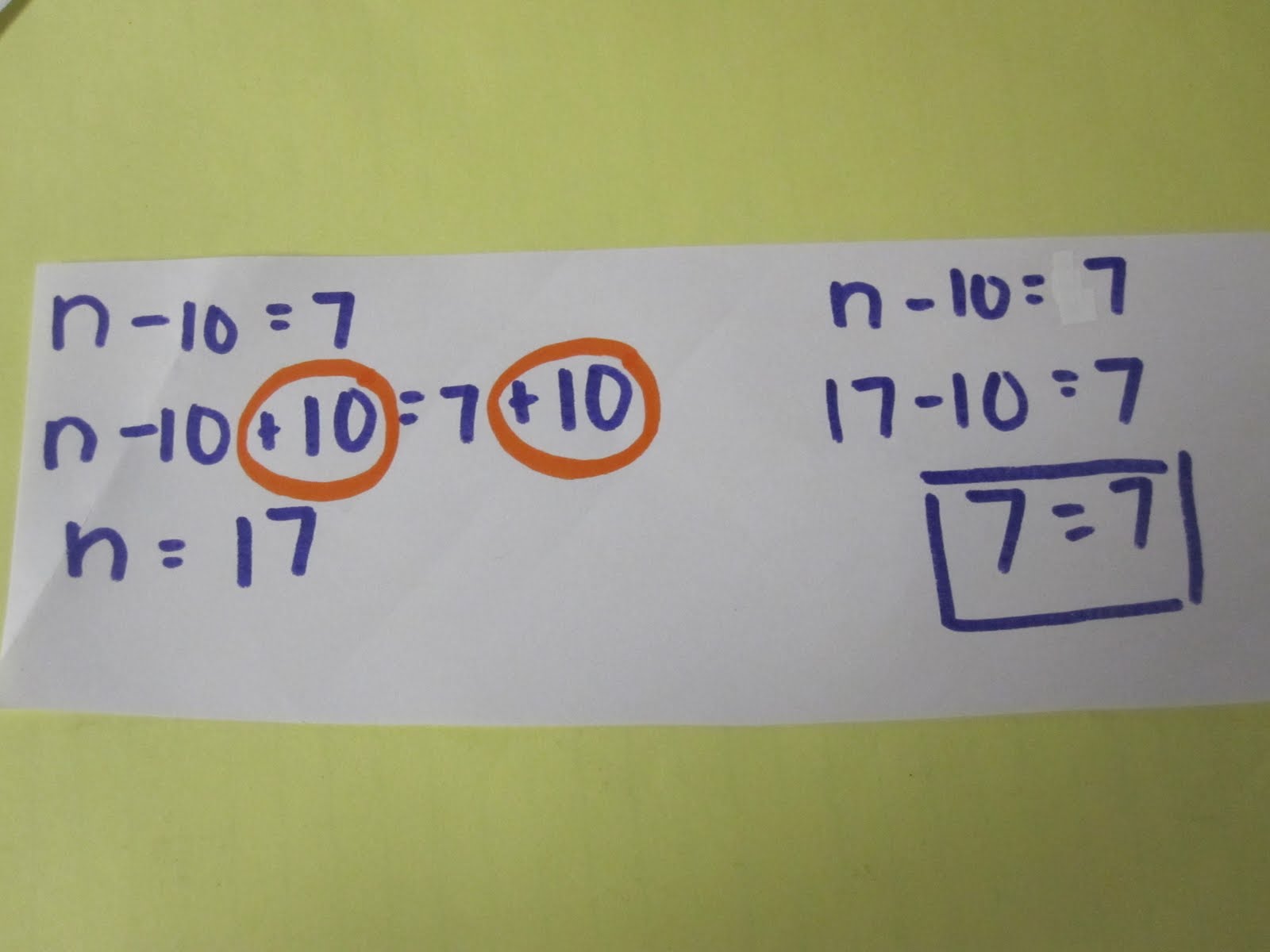

Multiplication:

Division:

How to solve Two Step Algebra Equations:
1) Isolate the variable
2) Cancel the constant
3) Balance both sides of the equals sign
4) Simplify the variable
5) Balance both sides of the equals sign again
6) Verify to check
** Here are some examples of Two Step Algebra Equations:
Multiplication:

Division:

Friday, March 11, 2011
Melanie's Great Big Book of Integers
Chapter 1: Grade 7 Integer Review
In class, we discussed the different ways you can solve integer questions. The two ways are:

* Remember the rule, " When subtracting something that isn't there, use a zero pair."
Here are some examples of integer questions (adding and subtracting) :
1. -3 - (-7) = +4

2. -3 -7 = -10

3. 3 - 7 = +10

4. 3 + 7 = +10

5. -3 +7 = +4

Chapter 2: Multiplying Integers
* A rule that will help you with multiplying integers is "The Sign Rule."
This rule states that:
Here are some examples of multiplication integer questions:
1. (+2) x (+3) = +6

2. (+2) x (-3) = -6

3. (-2) x (+3) = -6

4. (-2) x (-3) = +6

Chapter 3: Dividing Integers
* Partitive Division is spreading a the quotient into parts or groups. Here are examples of partitive division using a number line:
* Quotative Division is sharing the total with groups.
Example:

* The sign rule can really help you when solving integer questions.
* Reminder: The sign rule states that when you have an odd number of negative signs, the answer is negative but if there are an even number of negative signs, the answer is positive. For example: 1) 6÷2= +3
I knew this because the question had 0 negative signs which makes the answer a positive number.
2) -6 ÷ (-2)= +3
I knew that the answer is positive because there are 2 negative signs.
3) (-6)÷2= -3
There is an only 1 negative sign which means that the answer has to be negative.
4) 6÷(-2)= -3 The question has 1 negative sign which let me know that the answer is a negative.
Chapter 4: Order of Operations with Integers
Example:
(+5) x (-3) + (-6) ÷ (+3)=

* Remember that when solving questions such as the one above, you should use BEDMAS.
B= brackets
E= exponents
D= division
M= multiplication
A= addition
S= subtraction
*Here are the steps for solving questions such as the example above:
1) First you add square brackets around anything that needs to be multiplied or divided.
2) Then you multiply or divide whatever is in the square brackets.
3) You then do the same steps to whatever remaining numbers with the operation of multiplication or division.
4) Once completed that step, you then move on to addition and subtraction and just simply do the same.
* Remember to always move left to right when using BEDMAS.
In class, we discussed the different ways you can solve integer questions. The two ways are:
- using a number line
- using integer chips

* Remember the rule, " When subtracting something that isn't there, use a zero pair."
Here are some examples of integer questions (adding and subtracting) :
1. -3 - (-7) = +4

2. -3 -7 = -10

3. 3 - 7 = +10
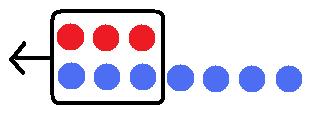
4. 3 + 7 = +10

5. -3 +7 = +4

Chapter 2: Multiplying Integers
* A rule that will help you with multiplying integers is "The Sign Rule."
This rule states that:
- Whenever you have an even number of negative factors, the product is positive.
- And when you have an odd number of negative factors, the product is negative
Here are some examples of multiplication integer questions:
1. (+2) x (+3) = +6

2. (+2) x (-3) = -6

3. (-2) x (+3) = -6

4. (-2) x (-3) = +6

Chapter 3: Dividing Integers
* Partitive Division is spreading a the quotient into parts or groups. Here are examples of partitive division using a number line:

* Quotative Division is sharing the total with groups.
Example:

* The sign rule can really help you when solving integer questions.
* Reminder: The sign rule states that when you have an odd number of negative signs, the answer is negative but if there are an even number of negative signs, the answer is positive. For example: 1) 6÷2= +3
I knew this because the question had 0 negative signs which makes the answer a positive number.
2) -6 ÷ (-2)= +3
I knew that the answer is positive because there are 2 negative signs.
3) (-6)÷2= -3
There is an only 1 negative sign which means that the answer has to be negative.
4) 6÷(-2)= -3 The question has 1 negative sign which let me know that the answer is a negative.
Chapter 4: Order of Operations with Integers
Example:
(+5) x (-3) + (-6) ÷ (+3)=

* Remember that when solving questions such as the one above, you should use BEDMAS.
B= brackets
E= exponents
D= division
M= multiplication
A= addition
S= subtraction
*Here are the steps for solving questions such as the example above:
1) First you add square brackets around anything that needs to be multiplied or divided.
2) Then you multiply or divide whatever is in the square brackets.
3) You then do the same steps to whatever remaining numbers with the operation of multiplication or division.
4) Once completed that step, you then move on to addition and subtraction and just simply do the same.
* Remember to always move left to right when using BEDMAS.
Thursday, March 10, 2011
Term 2 Reflection
This term I feel I did well on finding the volume of rectangular prisms and cylinders. I got the hang of the formulas quite quickly. I also think I did pretty good on the tests and quizzes but I definitely think that there’s always room for improvement. One thing I struggled in was finding the volume of a triangular prism, not that it was hard for me or anything, but sometimes I would forget to divide by two so I would get the wrong answer. Another thing was combining percents because it was a bit tricky especially when the number had a decimal. I would like to comment on the blog more often next term because I usually get lazy and forget about it. I would also like to participate more in class and communicate with my peers about the work we’re doing. I learned a lot about percents, volume and surface area this term such as how to find them, and the different things you can do with them. I learned how to combine percents and how to find the volume and surface area of three dimensional shapes. I also learned how I could use them in different situations.The difference between volume and surface area is the fact that volume is the amount of space an object takes up while surface area is sort of like the wrapping paper of the object, it’s the outside.
Thursday, February 17, 2011
Melanie's Volume Scribe Post
For my post, I will be answering the questions 4, 5, and 6 on the textbook work we did in class today. ( pages 258 - 261 )


*Sorry if some of the pictures are hard to see, just click it and it will appear bigger.
*Here is a link that will hopefully help those of you who don't understand how to find the volume of a rectangle / square.
If you guys don't agree with my answers, have different answers or have any suggestions, just leave a comment! :)
Cylinder Volume and Volume Problems

v= π x r x r
v= 3.14 x 12cm x 12 cm
v= 452.16 cm2 x 15
v= 6782.4 cm3
6782.4 cm3 / 4= 1695.6 cm3
The volume of cheese taken from the block was 1695.6 cm3.
One assumption I made was that they cut 1/4 from the cheese.

r= d/2
r= 0.8m/2
r= 0.4 m
v= π x r x r
v= 3.14 x 4cm x 4cm
v= 0.5024 cm2 x 10cm
v= 5.024 m3
r= d/2
r= 1m/2
r= 0.5m
v= π x r x r
v= 3.14 x 0.5m x 0.5m
v= 0.785 m2 x 10m
v= 7.85 m3
7.85 m3 - 5.024 m3 = 2.826 m3
The volume of concrete required to make the culvert is 2.826 m3.
Here is my volume video:


*Sorry if some of the pictures are hard to see, just click it and it will appear bigger.
*Here is a link that will hopefully help those of you who don't understand how to find the volume of a rectangle / square.
If you guys don't agree with my answers, have different answers or have any suggestions, just leave a comment! :)
Cylinder Volume and Volume Problems

v= π x r x r
v= 3.14 x 12cm x 12 cm
v= 452.16 cm2 x 15
v= 6782.4 cm3
6782.4 cm3 / 4= 1695.6 cm3
The volume of cheese taken from the block was 1695.6 cm3.
One assumption I made was that they cut 1/4 from the cheese.

r= d/2
r= 0.8m/2
r= 0.4 m
v= π x r x r
v= 3.14 x 4cm x 4cm
v= 0.5024 cm2 x 10cm
v= 5.024 m3
r= d/2
r= 1m/2
r= 0.5m
v= π x r x r
v= 3.14 x 0.5m x 0.5m
v= 0.785 m2 x 10m
v= 7.85 m3
7.85 m3 - 5.024 m3 = 2.826 m3
The volume of concrete required to make the culvert is 2.826 m3.
Here is my volume video:
Friday, January 14, 2011
Final Percent Post
What is a percent? A percent is out of a hundred. It is also another way of saying hundredths.
We recently learned about percents and did many things with them. We learned how to represent them in different ways, change them into fractions, decimals, and percents, how to find a percent of a number and how to combine percents.
Representing Percents:
You can use hundred grids to represent percents. You can also use more than one grid and shade part of a square.
Example: If you had to represent 180%, you would shade in one whole one hundred grid and 80 squares of another.
Fractions, Decimals, Percents:
You can use fractions and decimals to represent percents.
Example: 1/2 = 0.5 or 50%.
Percent of a Number:
To find the percent of a number, you can use some simple mental math strategies such as halving, doubling and dividing. You can also take the number and change it to a decimal then multiply that by the other number given.
Example: If you were finding 160% of $53.27...
1.60 x 53.27 = $85. 23
Combining Percents:
Percents can be combined by adding to help you solve problems. You can also use other strategies such as multiplying.
Example:
Ravi purchased 3 DVDs for $19.99 each.
Find the total cost for the DVDs including
5% GST and 6% PST.
$19.99 x 3 = $59.97
$59.97 x 1.11 = $66.5667
= $ 66.57
Here is my math video answering the four questions Mr. Harbeck gave us.
This is my percent post.
Here is a video that I hope will help you further understand percents.
We recently learned about percents and did many things with them. We learned how to represent them in different ways, change them into fractions, decimals, and percents, how to find a percent of a number and how to combine percents.
Representing Percents:
You can use hundred grids to represent percents. You can also use more than one grid and shade part of a square.
Example: If you had to represent 180%, you would shade in one whole one hundred grid and 80 squares of another.
Fractions, Decimals, Percents:
You can use fractions and decimals to represent percents.
Example: 1/2 = 0.5 or 50%.
Percent of a Number:
To find the percent of a number, you can use some simple mental math strategies such as halving, doubling and dividing. You can also take the number and change it to a decimal then multiply that by the other number given.
Example: If you were finding 160% of $53.27...
1.60 x 53.27 = $85. 23
Combining Percents:
Percents can be combined by adding to help you solve problems. You can also use other strategies such as multiplying.
Example:
Ravi purchased 3 DVDs for $19.99 each.
Find the total cost for the DVDs including
5% GST and 6% PST.
$19.99 x 3 = $59.97
$59.97 x 1.11 = $66.5667
= $ 66.57
Here is my math video answering the four questions Mr. Harbeck gave us.
This is my percent post.
Here is a video that I hope will help you further understand percents.
Sunday, December 19, 2010
Melanie Ilagan's Pay It Forward
Part one:
"Pay it Forward" is the idea that one person can make a difference by showing a simple act of kindness. This all started from the movie "Pay it Forward" where a seventh grader named Trevor was given the assignment to make a difference in the world. He thought of helping three people, then they would help another three and it would just keep going. He tried to do this many times, and though he thought he had failed, he actually affected many, many people. In the end, he died all because he tried to save someone from being bullied. Both this movie and project are very inspiring because they helped me open my eyes and realize how one simple act of kindness can bring joy into another person's life.
Part two:
For this project, I was in a group of four people: Kristel Aguason, Allison Manuel, Jocelle Garcia and myself. We decided that we wanted to help the less fortunate. To do this, we went to Superstore and around the school and collected donations which we would then give to Siloam Mission. However, we haven't yet brought it there. We probably will sometime this week. Anyways, in return for their kindness, we gave them a candy cane or chocolate. We did this from December 13 to 19

Part three:
I think our act of kindness went very, very well because we set a goal for ourselves of raising $100 and we exceeded that by over $100! In fact, we raised nearly $200! The people were actually proud of us for doing such a good thing towards the community. I even remember this one man saying "Wow, good job guys. Keep it up and good luck!" Some people even gave us suggestions such as to sing Christmas songs and to mention that we're going to give all the money to Siloam Mission and it made a difference. However, we didn't really ask the people to "Pay it Forward", we just mentioned "Pay it Forward" out loud a couple times but didn't ask them specifically. But I'm pretty sure we'll remember to say it once we bring all the proceeds to Siloam Mission. I felt really happy. We were even screaming and jumping in Superstore once we counted all the donations. It felt really good knowing that all the hard work and effort we put into the project was really worth it. I can't wait until we bring the money to Siloam Mission to see the smiles on their faces.
Part four:
I think the idea of "Paying it Forward" is important because it shows us how just one simple little act of kindness, whether it's saying thank you, handing out candy canes, or donating something to a charity can effect another person in one way or another. Also because I think that if we all learned how to "Pay it Forward" the world we live in today would be much more happier and peaceful. In my opinion, what we did will definitely make a difference towards the community and the people who rely on Siloam Mission because by doing what we did, they can finally have some warm meals, a place to stay and most importantly, happiness. This project really opened my eyes to see the effect someone can make on their community.
"Pay it Forward" is the idea that one person can make a difference by showing a simple act of kindness. This all started from the movie "Pay it Forward" where a seventh grader named Trevor was given the assignment to make a difference in the world. He thought of helping three people, then they would help another three and it would just keep going. He tried to do this many times, and though he thought he had failed, he actually affected many, many people. In the end, he died all because he tried to save someone from being bullied. Both this movie and project are very inspiring because they helped me open my eyes and realize how one simple act of kindness can bring joy into another person's life.
Part two:
For this project, I was in a group of four people: Kristel Aguason, Allison Manuel, Jocelle Garcia and myself. We decided that we wanted to help the less fortunate. To do this, we went to Superstore and around the school and collected donations which we would then give to Siloam Mission. However, we haven't yet brought it there. We probably will sometime this week. Anyways, in return for their kindness, we gave them a candy cane or chocolate. We did this from December 13 to 19

Part three:
I think our act of kindness went very, very well because we set a goal for ourselves of raising $100 and we exceeded that by over $100! In fact, we raised nearly $200! The people were actually proud of us for doing such a good thing towards the community. I even remember this one man saying "Wow, good job guys. Keep it up and good luck!" Some people even gave us suggestions such as to sing Christmas songs and to mention that we're going to give all the money to Siloam Mission and it made a difference. However, we didn't really ask the people to "Pay it Forward", we just mentioned "Pay it Forward" out loud a couple times but didn't ask them specifically. But I'm pretty sure we'll remember to say it once we bring all the proceeds to Siloam Mission. I felt really happy. We were even screaming and jumping in Superstore once we counted all the donations. It felt really good knowing that all the hard work and effort we put into the project was really worth it. I can't wait until we bring the money to Siloam Mission to see the smiles on their faces.
Part four:
I think the idea of "Paying it Forward" is important because it shows us how just one simple little act of kindness, whether it's saying thank you, handing out candy canes, or donating something to a charity can effect another person in one way or another. Also because I think that if we all learned how to "Pay it Forward" the world we live in today would be much more happier and peaceful. In my opinion, what we did will definitely make a difference towards the community and the people who rely on Siloam Mission because by doing what we did, they can finally have some warm meals, a place to stay and most importantly, happiness. This project really opened my eyes to see the effect someone can make on their community.
Sunday, December 5, 2010
Melanie's Percent Scribe Post
Page 135 - 136 (Questions 2, 4, 5, 8 & 10)


Please point out any errors I have made and remember to comment on all the blogs.
P.s. sorry if any of the pictures are hard to see.


Please point out any errors I have made and remember to comment on all the blogs.
P.s. sorry if any of the pictures are hard to see.
Monday, November 1, 2010
Scribe 1
Show You Know; Page 82
Write the prime factorization of each number. Which number is not a perfect square? Explain how you know.
a) 45 b) 100


Page 85
Question #1:
Explain how to square the number 7.
To do this, you would take the number 7 and multiply it by itself once.
Question# 5:
5. a) Determine the prime factorization of 4.
b) Is 4 a perfect square? Explain.
c) Draw the square and label its side length.

Question# 10:
Determine the area of a square with each side length.
a) 20 b) 17

Question #16:

Write the prime factorization of each number. Which number is not a perfect square? Explain how you know.
a) 45 b) 100


Page 85
Question #1:
Explain how to square the number 7.
To do this, you would take the number 7 and multiply it by itself once.
Question# 5:
5. a) Determine the prime factorization of 4.
b) Is 4 a perfect square? Explain.
c) Draw the square and label its side length.

Question# 10:
Determine the area of a square with each side length.
a) 20 b) 17

Question #16:

Reminder;
Tomorrow, we will be having a math quiz all about square numbers, roots and perfect squares! To know what to do, you must have all math pages complete because it will be based on the textbook work.
Please remember to comment on all the blogs.
Tomorrow, we will be having a math quiz all about square numbers, roots and perfect squares! To know what to do, you must have all math pages complete because it will be based on the textbook work.
Please remember to comment on all the blogs.
Sunday, October 17, 2010
Melanie's Sesame Street Video Post
My group was made up of Kristel, Josell and myself.
Ratio:
Two term ratio- compares two quantities measured in the same units.
example- 2:3
Three term ratio- compares three quantities measured in the same units.
example- 2:3:4
Part to part ratio- compares different parts of a group to another part of the same group.
example- 4:2
a diagram of a two term ratio:

Rates:
rate- compares two quantities measured in different units.
example- 2m/8hr
unit rate- a rate in which the second term is one.
example- 3km/1m
unit price- a unit rate used when shopping.
example- $4/5pencil
a diagram of a unit price:

Proportional Reasoning:
-a relationship that says that two ratios or two rates are equal.
example- 1/2 = 7/14

This is the video my group chose. It's about how Abby tries to make a doll from magic for Elmo.
This is our remake of the video.
Ratio:
Two term ratio- compares two quantities measured in the same units.
example- 2:3
Three term ratio- compares three quantities measured in the same units.
example- 2:3:4
Part to part ratio- compares different parts of a group to another part of the same group.
example- 4:2
a diagram of a two term ratio:

Rates:
rate- compares two quantities measured in different units.
example- 2m/8hr
unit rate- a rate in which the second term is one.
example- 3km/1m
unit price- a unit rate used when shopping.
example- $4/5pencil
a diagram of a unit price:

Proportional Reasoning:
-a relationship that says that two ratios or two rates are equal.
example- 1/2 = 7/14

This is the video my group chose. It's about how Abby tries to make a doll from magic for Elmo.
This is our remake of the video.
Saturday, October 2, 2010
Melanie's Math Profile
Hey, my name is Melanie and I am in grade 8 math. If you were to ask me if I like math, I would honestly say no because it is not my best subject. Something that I struggle in is solving math problems but I would definitely like to improve. A math activity that i really enjoyed was when I was in grade 1 and we were learning how to add. To help us we used smarties and once we were done, we got to eat them!
The unit I enjoyed learning about most in grade 7 was fractions. To me, it was pretty easy to understand and follow so I feel I did pretty good in that unit. But there were also some things I struggled in such as ratios. I had a hard time using ratio tables especially when we weren't using friendly numbers. I also had a hard time in algebra because sometimes when solving equations, I would forget a step. To help me not struggle as much in class, I would like to be not as shy to approach the teacher and ask him for help. I could also study and review my notes more often.
This year, I will try my best to be a good math student. To do this, I will try to participate more in class and always pay attention. I would also like to get all assignments completed on time. There's nothing in particular that I would like to learn this year but I would like to learn many new things to help me prepare for next year and the years after.
Last year, we had to do blogs talking about what we learned about in class. My favourite post that I made was all about bisecting perpendicular lines. It explained what they were and how to make one. Blogging helped me become a better student because by either making a post or viewing a post, you get to review everything you learned in class that day. I think by doing computer activities such as playing games, it could help us understand the topic more but also it is a more fun way to learn. I really hope to be doing that this year. I would also like to continue blogging.
The unit I enjoyed learning about most in grade 7 was fractions. To me, it was pretty easy to understand and follow so I feel I did pretty good in that unit. But there were also some things I struggled in such as ratios. I had a hard time using ratio tables especially when we weren't using friendly numbers. I also had a hard time in algebra because sometimes when solving equations, I would forget a step. To help me not struggle as much in class, I would like to be not as shy to approach the teacher and ask him for help. I could also study and review my notes more often.
This year, I will try my best to be a good math student. To do this, I will try to participate more in class and always pay attention. I would also like to get all assignments completed on time. There's nothing in particular that I would like to learn this year but I would like to learn many new things to help me prepare for next year and the years after.
Last year, we had to do blogs talking about what we learned about in class. My favourite post that I made was all about bisecting perpendicular lines. It explained what they were and how to make one. Blogging helped me become a better student because by either making a post or viewing a post, you get to review everything you learned in class that day. I think by doing computer activities such as playing games, it could help us understand the topic more but also it is a more fun way to learn. I really hope to be doing that this year. I would also like to continue blogging.
Subscribe to:
Posts (Atom)