Showing posts with label multiplying integers. Show all posts
Showing posts with label multiplying integers. Show all posts
Tuesday, March 29, 2011

Friday, March 25, 2011
Wednesday, March 23, 2011
Cathlene's Great Big Book Of Integers
Chapter 1


Grade 7 Integer Review
-3 - (-7) =

-3 - 7 =

3 - 7 = -4

3 + 7 = 10

-3 + 7 =

Multiplying Integers
(+2) x (+3) = 6

(+2) x (-3) = -6

(-2) x (-3) = -6

(-2) x (-3) = +6


Chapter 3
Partitive division is when you are given a number of group and you are asked to find out how many things can be in each group.
EXAMPLES OF PARTITIVE DIVISION


Quotative Division
Quotative division is when you are given an amount of item and you are asked to put it into groups.
EXAMPLE OF QUOTITIVE DIVISION


EXAMPLE FOR SIGN RULE

Chapter 4
Operations with Integers

Kevin's Big Book Of Intergers
Chapter 1:


 \
\


The Grade 7 Math review
Integers are basically positives (+), negatives (-), and zeropairs.
What I remembered:
-Integers can be shown on a number line.
-The rhyme "When subtracting something that isn't, there use a zero pair"
The * question we have to do:
(-3)-(-7)=
-3-7=
\3-7=
3+7=
Chapter 2 Multiplying Integers:
Examples:
(+2)x(+3)=6
It basically means you have 2 groups of 3.
2x(-3)=(-6)
When you have a negative on the right, it is just the same thing except the number is negative
(remember + and a - make a -, a - and a - make a +)
(-2)x(+3)=-6
-2x(-3)=6
Chapter 3:
Dividing Integers
Partitive Division:
Partitive division is how many groups of something are in something. We use a number line to show this.
Quotative Division:
This really just means "How do you share 6 with 2?"
The multiplicative inverse can helps us solve division questions because if we divide 6 by 2 we have 3. Now 3, we know that 3x2 equals 6 or 2x3 equals 6.
Chapter 4 :Order of Operations with Integers
(+5) x (-3) + (-6) ÷ (+3)=
[(+5) x (-3)] + [(-6) ÷ (+3)]=
(-15) + (-2) = -17
(-15) + (-2) = -17
Use BEDMAS :)!
BEDMAS stands for Brackets,Exponents,Division, Multiplication,Addition,Subtraction.
1. First off, put square brackets that need to be done first (Example 4/2)
2. Solve what you bracketed then rewrite what you have.
3. Now solve the equation from left to right using BEDMAS! :^)
Tuesday, March 22, 2011
Errol's Great Big Book of Integers
Chapter 1: Grade 7 Review
-A zero pair are 2 integers that have the same value but has opposite signs.
Ex. (+9) and (-9) equal 0
-Integer problems can be solved using a number line or chips. When using chips a red chip would represent a positive integer and a blue chip would represent a negative integer, so one blue chip and one red chip would equal a zero pair.
-A rule to remember when subtracting integers is "when subtracting something that isn't there use a zero pair"
In class we where asked to solve these problems:
1) -3 - (-7)= +4

2) -3 -7= -10

3) 3 -7= -4

4) 3 + 7= 10

5) -3 +7

Chapter 2: Multiplying Integers
Sign rule: when you have an odd amount of negative signs the product will be negative, when you have an even amount of negative signs the product will be positive. Here are some examples:
1. (+2) x (+3)= 6

(+2) x (-3)= -6
(-2) x (+3)= -6
(-2) x (-3)= +6
How I solved these questions:
Chapter 3: Dividing Integers
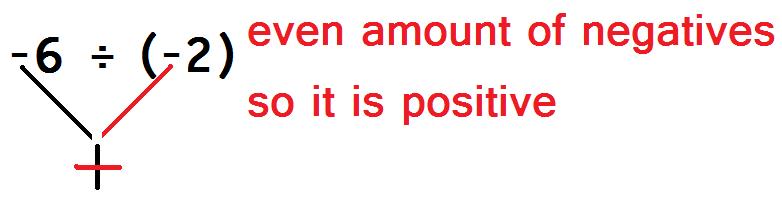
Sign Rule Works with Dividing Integers too. When you have an odd amount of negative signs the quotient will be negative, when you have an even amount of negative signs the quotient will be positive.
Partitive Division is how many groups are between 0 and a number.
Example 6÷2=3

-6÷ (-2)=3

Quotative Division is when finding how many
objects are in each group then finding how many
groups there are.
How do you share (-6) with 2 groups?
(-6)÷2= -3

Multiplicative Inverse is when you switch the quotient with the divisor or dividend.
Example: 6÷(-2)=
Make the question: -2 ÷ _ = 6. So 2 x 3 is 6 and since the 2 is negative, the 3 has to be negative because the answer is positive.
6÷2= answer would be positive because there are no negatives
-6÷ (-2)= answer would be positive because there is an even amount of negatives which is 2
(-6)÷2= answer would be negative because there is an odd amount of negatives which is 1
6÷(-2)= answer would be negative because there is an odd amount of negatives which is 1
Chapter 4: Order of Operations with Integers
BEDMAS is an order of operation
B- Brackets
E- Exponents
D- Division
M- Multiplication
A- Addition
S- Subtraction
(+5) x (-3) + (-6) ÷ (+3)= First we look for bracketed operations, since there are
none we look for multiplication or division looking from
left to right, and since there are I put a square bracket.
[(+5) x (-3)] + (-6) ÷ (+3)= Now we do the multiplication in the square brackets.
(-15) + (-6) ÷ (+3)= Now we square bracket the division.
(-15) + [(-6) ÷ (+3)]= Now we do the division in the square bracket.
(-15) + (-2)= Now add the numbers.
= (-17)
-A zero pair are 2 integers that have the same value but has opposite signs.
Ex. (+9) and (-9) equal 0
-Integer problems can be solved using a number line or chips. When using chips a red chip would represent a positive integer and a blue chip would represent a negative integer, so one blue chip and one red chip would equal a zero pair.
-A rule to remember when subtracting integers is "when subtracting something that isn't there use a zero pair"
In class we where asked to solve these problems:
1) -3 - (-7)= +4

2) -3 -7= -10

3) 3 -7= -4

4) 3 + 7= 10

5) -3 +7

Chapter 2: Multiplying Integers
Sign rule: when you have an odd amount of negative signs the product will be negative, when you have an even amount of negative signs the product will be positive. Here are some examples:
1. (+2) x (+3)= 6

(+2) x (-3)= -6
(-2) x (+3)= -6
(-2) x (-3)= +6
How I solved these questions:
Chapter 3: Dividing Integers
Sign Rule Works with Dividing Integers too. When you have an odd amount of negative signs the quotient will be negative, when you have an even amount of negative signs the quotient will be positive.
Partitive Division is how many groups are between 0 and a number.
Example 6÷2=3

-6÷ (-2)=3

Quotative Division is when finding how many
objects are in each group then finding how many
groups there are.
How do you share (-6) with 2 groups?
(-6)÷2= -3

Multiplicative Inverse is when you switch the quotient with the divisor or dividend.
Example: 6÷(-2)=
Make the question: -2 ÷ _ = 6. So 2 x 3 is 6 and since the 2 is negative, the 3 has to be negative because the answer is positive.
6÷2= answer would be positive because there are no negatives
-6÷ (-2)= answer would be positive because there is an even amount of negatives which is 2
(-6)÷2= answer would be negative because there is an odd amount of negatives which is 1
6÷(-2)= answer would be negative because there is an odd amount of negatives which is 1
Chapter 4: Order of Operations with Integers
BEDMAS is an order of operation
B- Brackets
E- Exponents
D- Division
M- Multiplication
A- Addition
S- Subtraction
(+5) x (-3) + (-6) ÷ (+3)= First we look for bracketed operations, since there are
none we look for multiplication or division looking from
left to right, and since there are I put a square bracket.
[(+5) x (-3)] + (-6) ÷ (+3)= Now we do the multiplication in the square brackets.
(-15) + (-6) ÷ (+3)= Now we square bracket the division.
(-15) + [(-6) ÷ (+3)]= Now we do the division in the square bracket.
(-15) + (-2)= Now add the numbers.
= (-17)
Saturday, March 19, 2011
Olivia's Great Big Book Of Integers
Chapter 1


Grade 7 Integer Review
A zero pair is two numbers, one positive and one negative, that have the same value and equal zero when you add them. Eg. -2, (+)2 = 0. A saying that helps you subtract integers is, "When subtracting something that isn't there, use a zero pair."
When subtracting or adding integers, you can use a number line or integer chips to help you. When you use chips, generally red symbolizes positive and blue symbolizes negative.
1) -3 - (-7) = +4
2) -3 - 7 = -10

3) 3 - 7= -4

4) 3+7 = +10

5) -3 + 7 = +4

Chapter 2
Multiplying Integers
1. (+2) x (+3)

2. (+2) x (-3)

3. (-2) x (+3)

- need 2 groups of (+3) zero pairs, then remove 2 groups of (+3)
- factors (-2), (+3) tell you how many zero pairs you need
4. (-2) x (-3)

The Sign Rule (regarding negative signs)

Chapter 3
Dividing Integers
Partitive Division is when you know how many groups there are and you want to find how many items are in each group; making parts.
Eg.
6 ÷ 2 = 3


-6 ÷ (-2) = -3

Quotative Division is when you know how many items are in each group and you are trying to find the number of groups; sharing you total with groups.
Eg.
(-6) ÷ 2 = -3

Multiplicative inverse to solve 6 ÷ (-2) = :
6 ÷ (-2) = (-6) ÷ 2 = -3
The sign rule for division is the same as the sign rule for multiplication, addition, and subtraction.
Eg.
6 ÷ 2 = 3 There are no negative signs in the question, therefore the answer it positive.
-6 ÷ (-2) = 3 There is an even number of negative signs in the question, so the answer is positive.
(-6) ÷ 2 = -3 There is an odd number (one) of negative signs in the question, therefore the answer is negative.
6 ÷ (-2) = -3 There is one negative sign in the question, therefore the answer is negative.
Chapter 4
Order of Operations with Integers
Use BEDMAS to solve equations, don't use 'E'.
Steps to solve (+5) x (-3) + (-6) ÷ (+3)=
1. Put square brackets around the operation that has to be done first (multiplication, division, addition or subtraction in order from left to right) and solve.

2. Put square brackets around the operation that has to be done next and solve.

3. If necessary, continue steps.
Here are all the steps together:

Subscribe to:
Posts (Atom)