Showing posts with label dividing integers. Show all posts
Showing posts with label dividing integers. Show all posts
Friday, March 25, 2011

Thursday, March 24, 2011
Arween's Great Big Book Of Integers
Chapter 1 : Grade 7 Integer Review

“When subtracting something that isn’t there use a zero pair”
Examples:-3 - (-7)=

-3 - 7 =

3 - 7 =

3 + 7 =

-3 + 7 =

Chapter 2 : Multiplying Integers
Sign rule: when you are multiplying integers and you have 0 or even numbers of negatives, the answer is positive. When you are multiplying integers and you have odd numbers of negatives, the answer is negative.
Sign rule: when you are multiplying integers and you have 0 or even numbers of negatives, the answer is positive. When you are multiplying integers and you have odd numbers of negatives, the answer is negative.
Examples:
(+2) x (+3)=

(+2) x (-3)=

(-2) x (+3)=

(-2) x (-3)=

Chapter 3 : Dividing Integers
Partitive Division is how many groups are there in a number.
6 ÷ 2 =

Quotative division is how to share a number into groups
6 ÷ 2 =
6 ÷ 2 =

Sign rule:
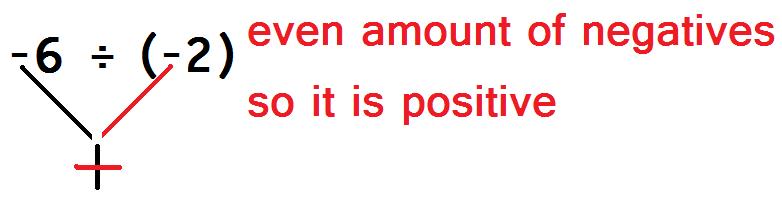
Even: when numbers of negative integers are even the answer is positive
Even: when numbers of negative integers are even the answer is positive
Odd: when numbers of negative integers are odd the answers is negative
6 ÷ 2 = 3 There are no negative integers so that means the quotient is positive.
-6 ÷ (-2) = 3 There are two (even) negative integers that means the quotient is positive.
(-6) ÷ 2 = -3 There is a negative integer (odd) that means the quotient is negative.
6÷(-2) = -3 There’s one negative integer that means the quotient is negative.
Chapter 4 : Order of Operations with Integers
(+5) x (-3) + (-6) ÷ (+3)
-15 + (-6) ÷ (+3)
-15 + -2
-17
When answering Order of Operations remember B.E.M.D.A.S
B = Brackets
E = Exponent
M = Multiplication
D = Division
A = Addition
S = Subtraction
1. First answer numbers with brackets Ex. ( ) or [ ]
2. Then Answer Multiplication and Division
3. Then Addition and Subtraction
6 ÷ 2 = 3 There are no negative integers so that means the quotient is positive.
-6 ÷ (-2) = 3 There are two (even) negative integers that means the quotient is positive.
(-6) ÷ 2 = -3 There is a negative integer (odd) that means the quotient is negative.
6÷(-2) = -3 There’s one negative integer that means the quotient is negative.
Chapter 4 : Order of Operations with Integers
(+5) x (-3) + (-6) ÷ (+3)
-15 + (-6) ÷ (+3)
-15 + -2
-17
When answering Order of Operations remember B.E.M.D.A.S
B = Brackets
E = Exponent
M = Multiplication
D = Division
A = Addition
S = Subtraction
1. First answer numbers with brackets Ex. ( ) or [ ]
2. Then Answer Multiplication and Division
3. Then Addition and Subtraction
Wednesday, March 23, 2011
Jocelle’s Great Big Book of Integers
Chapter 1 : Grade 7 Integer Review


Reminder :
- Integers can be represented on a number line.
- When subtracting something that isn't there, use a zero pair.
Examples :


Chapter 2 : Multiplying Integers


The Sign Rule :

Chapter 3 : Dividing Integers

Example:

The sign rule for division is the same as the sign rule for multiplication, addition, and subtraction.
6 ÷ 2 = 3 There are no negative signs in the question, therefore the answer it positive.
(-6) ÷ 2 = -3 There is an odd number (one) of negative signs in the question, therefore the answer is negative.
6 ÷ (-2) = -3 There is one negative sign in the question, therefore the answer is negative.
Chapter 4 : Order of Operations with Integers
Use B.E.D.M.A.S. to solve equations except "E"

Cathlene's Great Big Book Of Integers
Chapter 1


Grade 7 Integer Review
-3 - (-7) =

-3 - 7 =

3 - 7 = -4

3 + 7 = 10

-3 + 7 =

Multiplying Integers
(+2) x (+3) = 6

(+2) x (-3) = -6

(-2) x (-3) = -6

(-2) x (-3) = +6


Chapter 3
Partitive division is when you are given a number of group and you are asked to find out how many things can be in each group.
EXAMPLES OF PARTITIVE DIVISION


Quotative Division
Quotative division is when you are given an amount of item and you are asked to put it into groups.
EXAMPLE OF QUOTITIVE DIVISION


EXAMPLE FOR SIGN RULE

Chapter 4
Operations with Integers

Subscribe to:
Posts (Atom)